| Course Name | DYNAMICS OF LEADERSHIP |
| Course Code | UHPS6013-51 |
| Lecturer and Faculty | Dr. Roslizam bin Hassan Faculty of Educational Sciences and Technology |
| Student Name | Sharina binti Hashim |
| Student Matric Number | MHL254004 |
TRANSFORMATIONAL LEADERSHIP
Definition
Transformational Leadership as a term was first introduced in 1973 by James V. Downton Jr., an American political sociologist and leadership scholar through his doctoral dissertation titled “Rebel Leadership: Commitment and Charisma”. Robert J. House in his 1976 in his work, A Theory on Charismatic Leadership then explained the concept further, focusing on the charisma aspect.
Thereafter, Max Weber between 1992 and 1947 introduced ‘charismatic authority”. Essentially, while Downton coined the term and later scholars researched on the concept of charisma, later scholars James MacGregor Burns, in 1978, and Bernard M. Bass, in 1985, expanded the concept (Shrestha, M. (2020).
According to the authors Bass and Riggio, transformational leaders “…are those who stimulate and inspire followers to both achieve extraordinary outcomes and, in the process, develop their own leadership capacity”.
Further to this, Transformational Leadership has also been defined as “…a style where leaders inspire and motivate their team by creating a clear vision, encouraging innovation and fostering personal growth” (Ugochukwu, C. 2025).
Transformational Models and Dimensions
One of the more widely used models of Transformational Leadership is the Four I’s Model, developed by Bass, Avolio and Atwater (1996). Based on this model (as depicted in the diagram below), individuals who exhibit transformational leadership attributes have the 4 I’s to varying degrees.
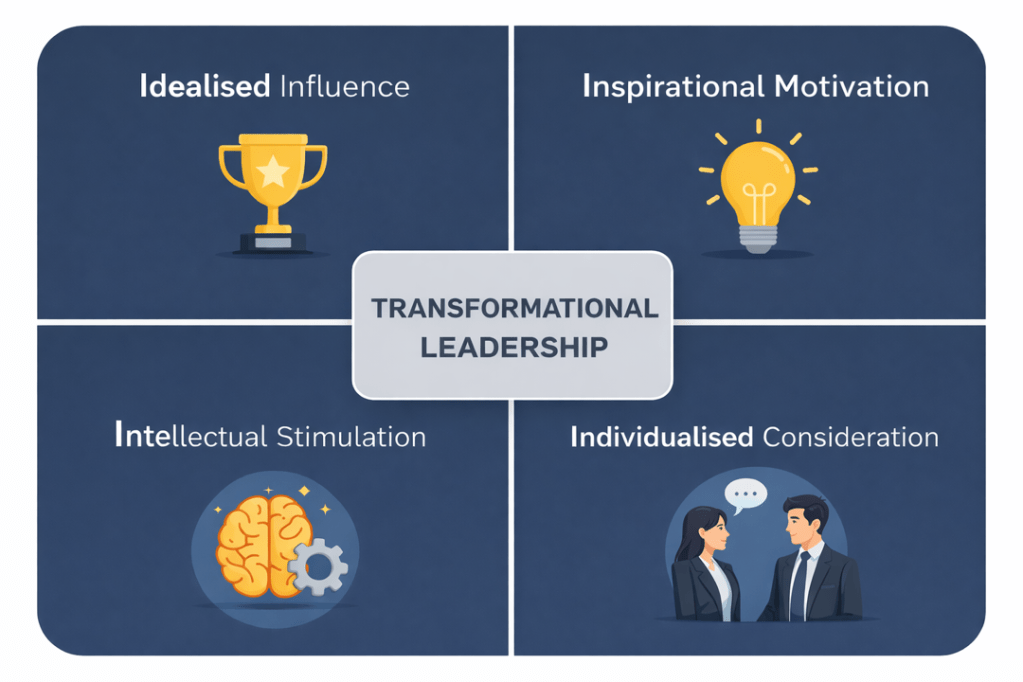
- Idealised Influence. This dimension describes leaders who have charisma and are respected as role models. In fact, charisma, (which, based on my readings of several scholarly articles on the subject-I will describe as ‘the natural ability to make others feel drawn to the person, to trust the person and to want to follow the person’s lead’), is one of the key components of this dimension. It is essential as it enables the leader to rally their followers around a shared vision.
- Inspirational Motivation. This dimension describes leaders who express optimism and commitment towards achieving a compelling vision while at the same time motivating their followers to commit to the same vision. To do this well, the leaders must have the capability to articulate their vision in a way that resonates with their followers’ values and aspirations. Curating their communication style to meet the needs of their followers is key. Within this component, the energy and enthusiasm demonstrated by the leader will encourage their followers to move forward with their goals.
- Intellectual Stimulation. This dimension describes leaders who encourage out-of-the-box thinking to foster creativity and innovation with the objective of achievement enterprise-wide improvements. The leader has the innate belief that his or her followers has untapped potential and pushes them out of their comfort zone to succeed beyond their expectations. In doing so, the leader must be mindful to be constructive and sensitive when giving feedback on areas for improvement, so as not to bring about distrust and ill-feeling.
- Individualised Consideration. This dimension relates to how the leader is able to provide support to meet each individual’s needs. To do everyone’s need to recognise and understand their followers’ motivations, needs and aspirations and to guide and support them with empathy. A high level of emotional intelligence is probably required on the part of the leader to do this competently.
Strengths and Weaknesses
Below are several strengths and weaknesses of Transformational Leadership:
| Strengths | Weaknesses |
| ✔ Positive Change & Motivation Transformational leaders inspire followers to embrace change and exceed expectations, fostering high levels of motivation and engagement. | ⚠ Dependency on Leader for Vision The effectiveness of transformational leadership relies heavily on the leader’s ability to articulate a clear and compelling vision; without it, the approach may lose impact. |
| ✔ Enhanced Performance This leadership style is associated with higher organisational commitment, job satisfaction, and overall performance compared to more transactional approaches. | ⚠ Potential for Stress Continuous pressure for change and innovation can increase stress among followers, particularly if emotional support is insufficient. |
| ✔ Innovation & Adaptability By promoting intellectual stimulation, transformational leaders encourage creativity, continuous learning, and adaptability in dynamic environments. | ⚠ Context-Dependent Effectiveness Transformational leadership is most effective in change-oriented or innovative contexts and may be less suitable in highly structured or routine environments. |
World Transformational Leadership
Below are examples of world leaders who have been frequently cited as exhibiting transformational leadership characteristics:
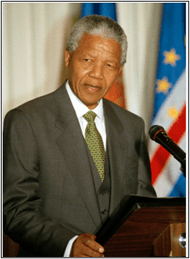
Nelson Mandela
Activist and Former President of South Africa (1994 to 1999)
Why transformational: Mr. Mandela articulated a compelling vision of reconciliation after the end of apartheid regime. He inspired a collective moral purpose and prioritised national unity over retribution. His leadership transformed both political structures and social attitudes.

Jacinda Ardern
Prime Minister of New Zealand (2017 to 2023)
Why transformational: Ms. Arden demonstrational inspirational motivation through empathetic, values driven leadership, particularly during national and global crisis such as COVID-19 and the Christchurch mosque attacks.

Barack Obama
44th President of the United States (2009 to 2017)
Why transformational: Mr. Obama emphasised hope, inclusion and long-term reform, motivating followers to engage in civic responsibility and institutional change rather than short-term political gain.
Previous Research Related to Transformational Leadership
Although Bass and Avolio’s 4 I’s Model may be the most widely used framework for transformational leadership, as alluded to at the beginning of this report, the concept itself evolved from Downton, House, Weber and Burns, who progressively shifted the leadership theory from authority-based towards values-based transformation.
Comparison between Transformational Leadership and Charismatic Leadership
Charismatic Leadership is a leadership theory first introduced by Max Weber, a German sociologist, economist and political theories who was widely regarded as one of the founders of modern social science. He developed the concept of charismatic authority in the early 1900s, particularly in his work Economy and Society that was published in 1922 where he sought to understand, among other things, why people obey leaders. His theory on Charismatic Leadership explains how leaders influence followers through personal appeal, emotional engagement, and perceived extraordinary qualities.
Based on scholarly studies (Antonakis, J. (2012), Mittal, R. (2015), below is a comparison between this theory and Transformational Leadership:
| Dimension | Transformational Leadership | Charismatic Leadership |
| Core Focus | Collective vision and long-term change. | Leader’s personal appeal and influence. |
| Source of Influence | Shared values, moral purpose and empowerment. | Personal charm, confidence and emotional appeal. |
| Follower Role | Actively developed and empowered. | Often dependent on the leader. |
| Sustainability | More sustainable due to systems and shared leadership. | Risk of decline if/when leader exits. |
| Risk Factors | Can cause stress if expectations are too high and emotional support minimal. | Risk of manipulation or hero-worship. |
| Outcome | Organisational or social transformation. | High motivation, but not always structural change. |
In making this comparison, there are several points to note:
- Charisma by itself does not equate to good leadership.
- Charismatic leadership can be either constructive or destructive.
- Outcomes depend on values, constraints, and institutions.
For example, according to Immelman (2017), while analyses of Donald J. Trump’s (the 45th and currently the 47th President of the United States) leadership style often highlight his charismatic appeal and ability to cultivate intense personal loyalty and emotional engagement among his followers, studies also suggest that charisma alone does not guarantee a transformational impact. In Trump’s case, the focus on personality-driven influence distinguishes his style from the classic transformational leadership as theorised by Burns and Bass.
References:
- Shrestha, M. (2020). Transformational leadership and its dimensions: Contributions in organizational change among schools. BSSS Journal of Management, 11(1), 112–130. https://doi.org/10.51767/jm1107
- Makadiya, D. (2021). What is transformational leadership? factoHR. https://factohr.com/hr-glossary/transformational-leadership/
- Ugochukwu, C. (2025). Transformational leadership style: How to inspire and motivate. Simply Psychology. https://www.simplypsychology.org/what-is-transformational-leadership.html
- Antonakis, J. (2012). Transformational and charismatic leadership. In D. V. Day & J. Antonakis (Eds.), The nature of leadership (2nd ed., pp. 256–288). SAGE Publications.
- Mittal, R. (2015). Charismatic and transformational leadership styles: A cross-cultural perspective. International Journal of Business and Management, 10(3), 26–33. https://doi.org/10.5539/ijbm.v10n3p26
- Immelman, A. (2017). The leadership style of U.S. President Donald J. Trump (Working Paper). Saint John’s University. https://digitalcommons.csbsju.edu/psychology_pubs/107/
 SharinaH Learns I Personal Learning Journal