| Course Name | DYNAMICS OF LEADERSHIP |
| Course Code | UHPS6013-51 |
| Lecturer and Faculty | Dr. Roslizam bin Hassan Faculty of Educational Sciences and Technology |
| Student Name | Sharina binti Hashim |
| Student Matric Number | MHL254004 |
Summary and Reflection for: ODL Synchronous Class Meeting 6 (15 January 2026)
LEVEL 5 LEADERSHIP / AUTHENTIC LEADERSHIP
For our final class for this course, Thurkgashirini Arumugam (Thurkga) shared on Level 5 Leadership. I note that this leadership concept is based on Jim Collin’s book, Good to Great and the author had authored this book after extensive research on companies to discover what is it that makes an already good company become truly great. According to Thurgka, Collins and his team had researched 1,435 companies before he produced this leadership concept.
As a Level 5 leader, one of the key characteristics is their humility or as Thurkga shared “…they take all the blame and give credit to other people.” This is especially so during times of crisis where leadership possessing the characteristics of a Level 5 leader “…burn themselves to the ground to make their companies shine.” On this, in his feedback, Dr. Roslizam highlighted the importance of understanding the difference between personal humility and low confidence. A key point I noted here is that a person who shows humility is by no means low in confidence. On reflection, it is more a question of ego.
Visualisation of the levels within this leadership concept is done via a pyramid as below.

Initially, I had thought that the 5 levels represented ‘types’ or personalities of people. However, after further research, I learnt that the levels describe 5 different ways an individual shows up as a leader. So, it is more like layers. In other words, the levels represent how much value an individual’s leadership creates and how wide their influence reaches.
On this, Thurkga also shared that there is a thin line between Level 4 and Level 5 leaders. In his feedback, Dr. Roslizam also highlighted this as a key point. Upon further research on the book’s key concepts, combined with Thurkga’s and Dr. Roslizam’s sharing, I noted that while Level 4 leaders are inspirational and intent on winning, Level 5 leaders want the organisation to win, even without them. As in the example provided by Thurgka, when the CEO of Mercedes Benz resigned, the company’s stock price was not adversely impacted. In comparison, when a Level 4 leader leaves, because the company’s success is very much linked to the leader, the company might experience a decline. However, when a Level 5 leader leaves, because he or she views himself or herself as more like a caretaker of something bigger, the company can continue to be great even without his or her presence. As Dr. Roslizam highlighted, Level 5 levels in an organisation don’t shine, but they are very important.
Another point that I also noted is that it is not necessarily an advantage to source for Level 5 leaders from within the company as opposed to sourcing from external. As pointed out by Dr. Roslizam, there are pros and cons to either option. Based on my own experience in the human resource area, I would concur with this viewpoint.
As part of the case study sharing, Thurkga shared on how the Petronas Chairman (President & CEO), Tan Sri Tengku Muhammad Taufik Tengku Aziz (Tan Sri Tengku Muhammad Taufik), showed personal humility in relation to an incident during the 2025 Singapore Formula 1 (F1) Grand Prix. As a result of the backlash received on his participation in the champagne shower at the podium, Tan Sri Tengku Muhammad Taufik had publicly apologised. In his feedback, Dr. Roslizam also highlighted a recent example where Malaysia’s Minister of Education, YB Puan Fadhlina Sidek demonstrated authenticity in her leadership style after listening and responding to requests and concerns by parents and educators on the possibility of reinstating the Ujian Pencapaian Sekolah Rendah (UPSR) and Pentaksiran Tingkatan 3 (PTS) examinations as well as on the possibility of instituting 360-degree evaluations of Pentadbir Guru Besar (PGB). In both instances, rather than simply dictating a position, she had demonstrated the humility and willingness to listen to the multiple stakeholders rather than dictating a position.
I was also intrigued by Thurkga’s personal sharing on how her motivation and engagement to continue to contribute in her company because of the company leadership’s commitment towards their employees learning and development. She also shared how the company is one of the top 5 in the fintech market and she views the CEO focusing more on promoting the company then on self-promotion. These, I felt, were characteristics leaning to a Level 5 leader and what a valuable developmental opportunity for Thurkga to experience this.
The final presentation for this course was by Mohd Marhanis Mirza bin Mahmod (Marhanis) on Authentic Leadership. Marhanis explained that this theory was conceptualised by author Bill George based on his book by the same name. In my research on this theory, I noted that Bill George was a former CEO of Medtronic, a global medical technology company. His leadership at Medtronic has been cited for its strong ethical culture, mission-driven focus and long-term performance. In his career after that as a Senior Fellow at Harvard Business School, together with scholars Bruce Avolio and Fred Luthans, they expanded the theory with research-based validation. My key learnings on this topic are as follows:
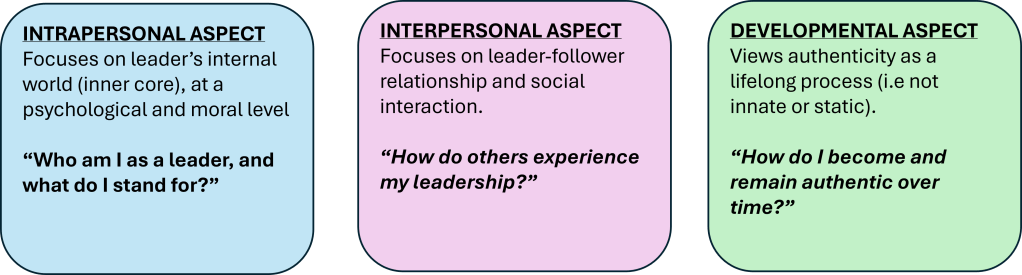
- Authentic leadership operates across 3 interconnected dimensions (as below) and when viewed together, it describes how authenticity is formed, expressed and sustained by leaders.
- This theory postulates a True North concept with 4 underlying principles as visualised in the diagram below.

In his feedback, Dr. Roslizam highlighted the significance of ‘Values and Principles’ and the reason for it to be positioned at the top of the compass diagram. From Dr. Roslizam’s sharing I understand how being true to one’s values and principles (one’s moral compass, one’s sense of purpose) is a key characteristic of an authentic leader.
In other words, during times of ‘business as usual’ as well as of crisis or disruptive transformation, an authentic leader operates based on his or her True North, or as Dr. Roslizam described in Bahasa Melayu as “…nilai-nilai yang memacu seseorang pemimpin ke arah yang betul.”
- In reference to the aspects of Authentic Leadership Theory, in his feedback, Dr. Roslizam also highlighted on the concept of Crucible Experiences and how these can shape one to become an authentic leader. Upon further research, I note that this concept lies within the Development aspect of Authentic Leadership. Within this theory, crucible experiences are life challenging moments that shapes a leader’s values, self-awareness and sense of purpose, and how it facilitates the leader discovery or reaffirmation of their ‘True North’. I see these in the examples of contemporary leaders provided by Marhanis namely Jacinda Ardem, Khairy Jamaluddin Abu Bakar, Tan Sri Tony Fernandes, Satya Nadella and Tun Mahathir Mohamed.
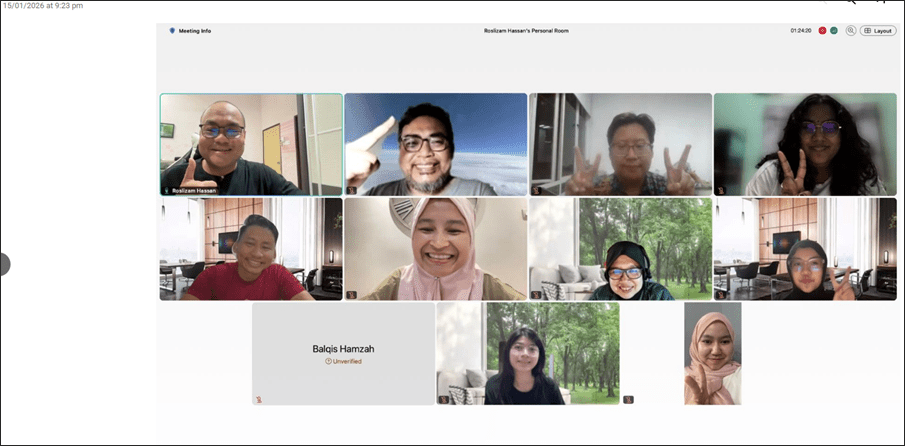
This being the last class for the course, Dr. Roslizam took a final group photo of us. At this point, I would like to take this opportunity to thank Dr. Roslizam for his guidance and wisdom shared throughout the course. He warmly invited us to come visit him in campus, an opportunity I certainly look forward to, InsyaAllah, in future, as I continue my post-graduate learning journey with UTM😊.
References:
- Jim Collins, “Level 5 Leadership: The Triumph of Humility and Fierce Resolve”, Harvard Business Review, 2005 (PDF)
- Gardner, W. L., Cogliser, C. C., Davis, K. M., & Dickens, M. P. (2011). Authentic leadership: A review of the literature and research agenda. The Leadership Quarterly, 22(6), 1120–1145. https://doi.org/10.1016/j.leaqua.2011.09.007
- Bartlett Martinez, K. (2016, August 30). Haven’t yet read True North? An opinion on the most provocative insights. LinkedIn. https://www.linkedin.com/pulse/havent-yet-read-true-north-opinion-most-provacative-kymm
 SharinaH Learns I Personal Learning Journal